Korea Transit Cards 2026: T-money vs WOWPASS vs Climate Card
🔗 Some links on this site are affiliate links. If you book through them, we may earn a small commission at no extra cost to you. We only recommend services we believe are genuinely useful for train travel in Korea.
The moment you land in Korea, you start tapping a card to go anywhere — the subway to your hotel, a bus to a palace, the all-stop train in from the airport. Korea is almost entirely cashless, and a single rechargeable transit card is the small purchase that makes the whole trip frictionless. The catch in 2026: there are three popular options, and they’re built for different travelers. This guide breaks down T-money, WOWPASS, and the Climate Card in plain terms — what each costs, where to get it, what it covers, and (just as important) what none of them cover: your KTX and SRT tickets are always separate.
The quick answer
If you only remember one thing: plain T-money is the safe default, WOWPASS adds payments and currency exchange for travelers whose cards get fussy, and the Climate Card is an unlimited pass that only makes sense if you stay in Seoul and ride a lot.
| T-money | WOWPASS | Climate Card | |
|---|---|---|---|
| Best for | Simple tap-and-go, any city | Payments + good exchange rates | Seoul-only trips, many rides/day |
| Cost | ~₩2,500–4,000 (card) | ₩5,000 (card) | ₩5,000–20,000 (1–7-day pass) |
| Where to get it | Convenience stores, station machines | Yellow kiosks; Incheon Airport arrivals | Station machines, convenience stores |
| Transit coverage | Subway, bus, taxi — nationwide | Same transit, nationwide | Seoul subway + bus + public bikes only |
| Also does | Small purchases at shops | Card payments + currency exchange | — (transit only) |
| KTX / SRT | ❌ separate ticket | ❌ separate ticket | ❌ separate ticket |
| Airport train from Incheon | ✅ AREX all-stop | ✅ AREX all-stop | ⚠️ tap out at the airport only |
T-money: the default tap-and-go card
T-money is Korea’s standard rechargeable transit card, and for most visitors it’s all you need. You tap it on the subway, city buses, and most taxis in every city — Seoul, Busan, anywhere — and it even covers small purchases at convenience stores. Transfers between bus and subway are discounted automatically when you tap in and out.
- Cost: about ₩2,500–4,000 for a basic card (designs vary).
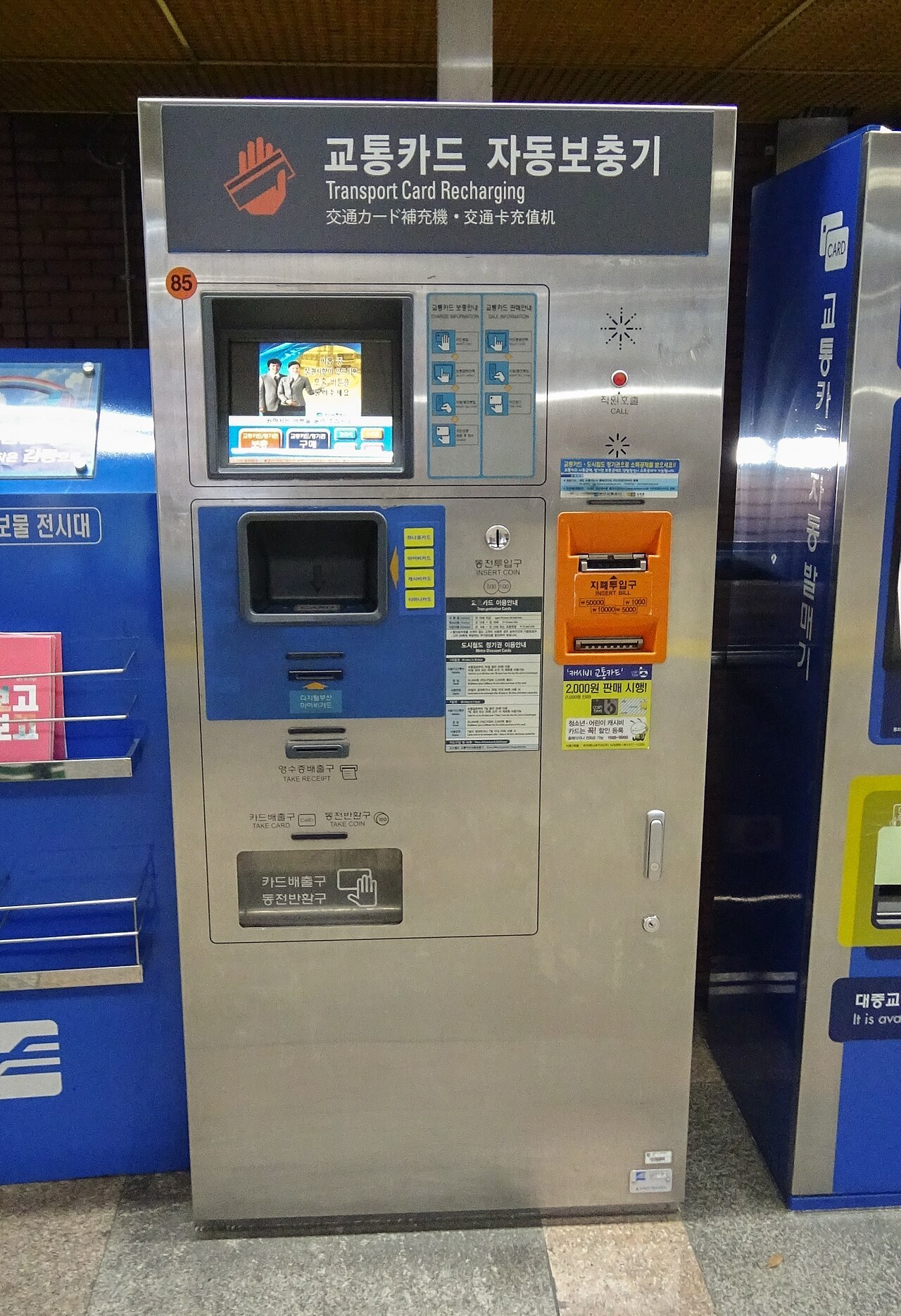
- Where: any convenience store (CU, GS25, 7-Eleven, Emart24) and subway-station machines. Just say “T-money card.”
- Topping up: add cash at convenience-store counters or station machines. The catch for foreigners — the recharge machines usually take cash only, not a foreign card. Carry some won, or see WOWPASS below.
- Refunds: you can get your leftover balance back (minus a small fee) at convenience stores before you fly home, up to a set limit.
Mobile T-money on your phone
Since 2025 you can carry T-money digitally: add it to Apple Wallet and tap with your iPhone or Apple Watch, or use the Mobile T-money app on Android. A March 2026 update finally added a “Foreigner” option to the app. One honest caveat: in-app top-ups still don’t accept Visa as of early 2026 (Mastercard and Amex work), so if you’re only here a few days, a physical card is the foolproof choice — buy it, load some cash, done.
To use any of this smoothly you’ll want a live data connection on arrival — the apps and Naver Map all need it.
WOWPASS: transit + payments + currency exchange in one
WOWPASS is built specifically for foreign visitors, and it solves a very real Korea headache: foreign credit cards that get declined at ticket machines, vending machines, and some shops. It’s really two cards in one:
- A prepaid payment card. You feed your home currency (JPY, USD, EUR, and 13-plus others) into a WOWPASS kiosk, and it loads Korean won at rates far better than airport exchange counters. That balance then works like a normal card almost everywhere.
- A built-in T-money transit balance, which you load separately with won (at convenience stores or station machines, or by transferring from your pay balance in the app — app transfers are iOS-only for now).
- Cost: ₩5,000 for the card, which the saved exchange and foreign-transaction fees usually earn back quickly.
- Where: the bright-yellow WOWPASS kiosks — including Incheon Airport arrivals (Terminals 1 and 2) and 300-plus subway stations, hotels, and tourist areas. Setup takes about five minutes.
- Validity: the card lasts six years; you can refund leftover pay balance to a foreign card through the app (small processing fee).
Who it’s for: travelers who don’t want to gamble on their card working, who’d otherwise change cash at a bad rate, or who just like having transit and payments on one card. If your card already works fine and you’re carrying some won, plain T-money is cheaper and does the transit part just as well.
The Climate Card: unlimited rides, Seoul only
The Climate Card (기후동행카드) is Seoul’s unlimited transit pass. Unlike T-money and WOWPASS, you don’t pay per ride — you buy a pass and ride as much as you want within Seoul. The city offers tourist-friendly short-term passes:
| Pass | Price |
|---|---|
| 1-day | ₩5,000 |
| 2-day | ₩8,000 |
| 3-day | ₩10,000 |
| 5-day | ₩15,000 |
| 7-day | ₩20,000 |
It covers unlimited Seoul subway, Seoul city buses, and Ttareungi public bikes. With a single subway ride at ₩1,550, the 1-day pass pays off from about four rides a day — realistic if you’re palace-hopping across the city, less so on a relaxed day.
The fine print that trips travelers up — what the Climate Card does not cover:
- The KTX, SRT, AREX Express, the Sinbundang Line, and GTX — none are included.
- Anything outside Seoul: subway stations in Gyeonggi or Incheon, wide-area (gwangyeok) buses, and intercity/airport buses. A day trip out to Suwon or Incheon isn’t covered.
- Coming in from Incheon Airport: you can’t tap in at the airport, so the Climate Card can’t bring you into the city. It does cover the opposite direction — Seoul lets Climate Card holders tap out at Incheon Airport T1 and T2, so your ride out on departure day is included.
2026 update: since 1 September 2026 the 30-day Climate Card has been folded into the national K-Pass and renamed the Climate Pass (기후동행패스) — prepaid 30-day passes could be charged until 31 August and used until 29 September, and post-paid cards kept their discount until 30 September. The good news for visitors: the short-term 1–7-day tourist passes continue unchanged. Many older guides miss this — and some still call it “Climate Card Plus”, a name Seoul did not use.
The big catch: none of these pay for your KTX
This is the point worth repeating, because it surprises people. No transit card — T-money, WOWPASS, or Climate Card — pays for a KTX or SRT seat. High-speed trains always need a separate reserved ticket. What these cards do is get you to and from the stations and around each city. For the trains themselves, see how to buy KTX tickets, the KTX vs SRT breakdown, and — if your foreign card keeps getting declined (the exact problem WOWPASS sidesteps) — how to book KTX with a foreign credit card. And if you’re taking several long-distance trains, check whether a Korail Pass beats single tickets — then how to actually use one.
The airport is the other place this matters. The Climate Card can’t bring you in from Incheon (it only lets you tap out there on your way home), but a T-money or WOWPASS card works on the AREX all-stop (“Blue line”) train as long as you’ve loaded at least ₩5,000. The faster AREX Express is a separate reserved ticket, not a tap-and-go fare. The full comparison — Express vs all-stop, fares, and timetables — is in our Incheon Airport to Seoul guide.
So which card should you get?
- Doing a multi-city trip (KTX out to Busan, Gyeongju, Gangneung) and you want one card for transit and payments and a fair exchange rate → WOWPASS, or T-money if your foreign card already works and you’re carrying won.
- Staying in Seoul and riding the subway and buses all day, every day → a Climate Card short pass, sized to your trip length.
- You just want the simplest thing that works in every city → T-money. It’s the boring, correct answer for most travelers.
- You’re an iPhone user who wants it on your phone → mobile T-money in Apple Wallet, with a physical card as backup until you’ve confirmed your card tops up in-app.
Whatever you pick, get the card sorted on day one and you’ll never think about it again — you’ll just tap and go, the way Korea is built to work.
FAQ
Which transit card is best for tourists in Korea? For most travelers, plain T-money is the simplest: tap onto any subway, bus, or taxi in any city. Choose WOWPASS if you want one card that also handles payments and currency exchange, or a Climate Card short pass if you’re staying in Seoul and riding all day.
Can I use T-money, WOWPASS, or the Climate Card for the KTX? No. None of these cards pay for KTX or SRT high-speed trains — those always need a separate reserved ticket. The cards cover the subway, buses, and the all-stop airport train that get you to and from the stations.
Does the Climate Card work from Incheon Airport? Only in one direction. You cannot tap in at Incheon Airport, so the Climate Card will not bring you into Seoul — use T-money or WOWPASS on the AREX all-stop train, or the AREX Express with a separate ticket. On the way out it does work: Seoul lets Climate Card holders tap out at Incheon Airport T1 and T2, so the ride to the airport on your departure day is covered.
Is WOWPASS worth it? It’s worth it if your foreign card tends to get declined in Korea or you’d otherwise exchange cash at a bad rate. If your card already works fine, plain T-money is cheaper and simpler.
Can I add T-money to my iPhone? Yes — since 2025 you can add a digital T-money card to Apple Wallet. Just check top-up support first: as of early 2026 in-app top-ups don’t yet accept Visa, so a physical card is the safe option for short visits.
Where do I buy these cards? T-money: any convenience store or subway machine. WOWPASS: the yellow kiosks in Incheon Airport arrivals and across the city. Climate Card: buy the short-term tourist pass at subway station machines or convenience stores in Seoul.
Related guides
- Do you need data in Korea? — why a connected phone (for Naver Map and the transit apps) is the other day-one essential.
- Incheon Airport to Seoul — AREX Express vs the all-stop train your transit card can ride.
- How to book KTX with a foreign credit card — the card-declined problem WOWPASS is built to solve.
- KTX vs SRT — the high-speed tickets no transit card covers.
- The ultimate Korea train travel guide — how the whole rail system fits together.
🔗 Affiliate disclosure: Some links on this site are affiliate links. If you book through them, we may earn a small commission at no extra cost to you. We only recommend services we believe are genuinely useful for train travel in Korea.